BOTANİC LABORATORY MICRCOSCOPE IMEGES PART - 2
- kubratas1582
- Jun 19, 2025
- 3 min read
Updated: Jul 7, 2025
CRYSTALS
In botanical studies, crystals are classified as inorganic inclusions within plant cells that perform a variety of physiological and protective functions. They are predominantly composed of calcium oxalate and calcium carbonate, with silica (silicon dioxide) occurring less frequently. These crystalline structures are typically localized within vacuoles, intercellular spaces, or associated with the cell wall. Their biogenesis is regulated by a combination of genetic programming and environmental stimuli.
They may be classified under different names based on their location, morphology, and structural characteristics.


TRİCHOMES
Trichomes are epidermal outgrowths commonly found on the aerial parts of plants, such as leaves and stems. They vary in structure—being unicellular or multicellular—and are generally categorized as non-glandular (mechanical) or glandular (secretory).
Non-glandular trichomes protect against herbivores, UV light, and excessive water loss by forming a physical barrier and increasing the leaf's boundary layer.
Glandular trichomes produce secondary metabolites like essential oils, resins, or enzymes, which play roles in plant defense and ecological interactions.
Overall, trichomes contribute significantly to plant survival by enhancing protection, reducing water loss, and mediating biotic relationships.


STOMAS
Stomata are microscopic pores located in the epidermis of plants, usually concentrated on the underside of leaves. Each stoma is bordered by two specialized guard cells that regulate its opening and closing. Stomata play a central role in gas exchange (CO₂ intake and O₂ release) and transpiration (water vapor loss). Their movement is influenced by environmental and internal factors such as light, carbon dioxide concentration, water availability, and plant hormones. While stomata allow CO₂ uptake for photosynthesis, they also contribute to water loss, making their regulation vital for maintaining plant homeostasis. Thus, stomata are essential in enabling plants to respond effectively to environmental stress.


SUPPORT TISSUE
Supporting tissues in plants provide mechanical strength and help maintain structure. There are two main types:
Collenchyma: Living cells with flexible, unevenly thickened walls; found in growing parts like stems and leaves. Mainly composed of cellulose and pectin.
Sclerenchyma: Dead cells with thick, lignified walls; found in mature parts. Includes fibers and sclereids.
Each type plays a vital role in keeping the plant upright and resistant to mechanical stress.


SECRETORY TISSUE
Secretory tissues in plants are specialized structures responsible for producing, storing, or releasing various substances such as resins, essential oils, latex, nectar, and digestive enzymes. These tissues are broadly classified into two types: external and internal. External secretory structures, such as glandular trichomes, oil glands, nectaries, and hydathodes, are located on or near the plant’s epidermis and release their secretions directly into the external environment. For example, the oil glands in the peel of citrus fruits like oranges are external and secrete aromatic oils. Internal secretory structures, including resin ducts, laticifers, and secretory cells, are embedded within the internal tissues like cortex or vascular bundles. They typically store substances inside the plant and release them only under specific conditions, such as injury—an example being resin canals in pine trees. Secretory tissues play critical roles in defense, attraction of pollinators, excretion, and storage of metabolic products.


TRANSMISSION BUNDLES
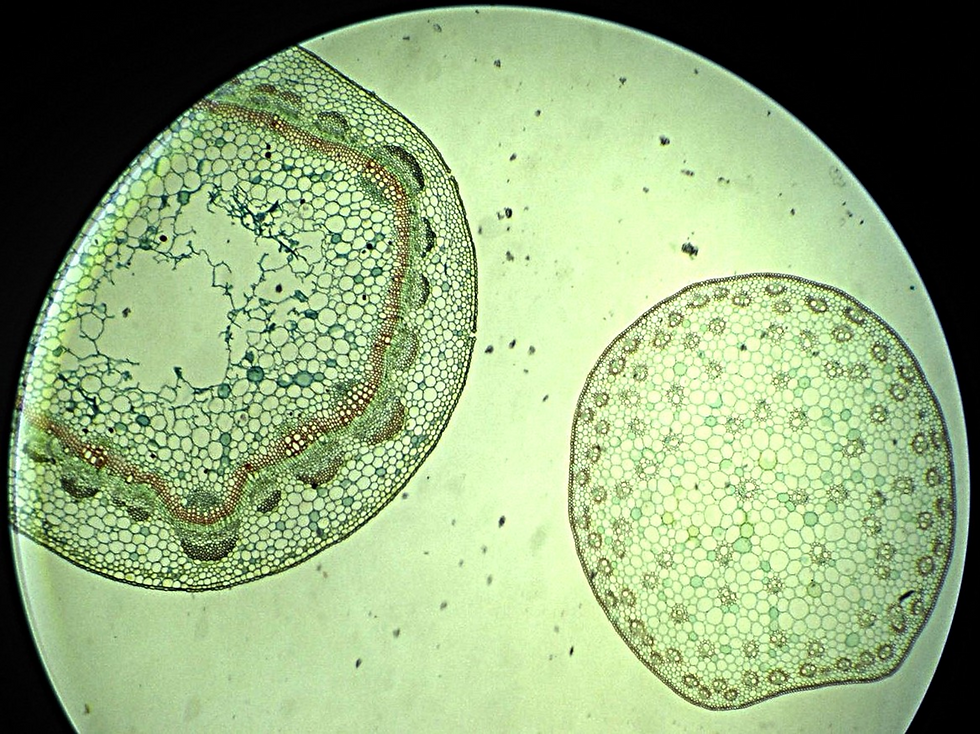
In vascular plants, the arrangement of vascular bundles differs significantly between monocots and dicots, and this distinction is a key identifying feature. In dicot stems, vascular bundles are typically arranged in a ring, with xylem on the inner side and phloem on the outer side, forming collateral bundles. This arrangement allows for the development of a vascular cambium between xylem and phloem, enabling secondary growth (increase in stem thickness). In contrast, monocot stems have scattered vascular bundles throughout the ground tissue. These bundles are usually closed (lack vascular cambium) and therefore do not show secondary growth. Additionally, monocot vascular bundles often appear more oval or rounded and are embedded in parenchymatic tissue without a defined ring structure. These anatomical differences reflect the contrasting growth patterns and structural support strategies between monocots and dicots.
1)DICOTYL (REGULAR)
2)MONOCOTYL (DISPERATE)

Source:
Franceschi, V. R., & Nakata, P. A. (2005). Calcium oxalate in plants: formation and function. Annu. Rev. Plant Biol., 56(1), 41-71.


HOW'S IT GOING WITH GUY'S----OVER THERE TODAY.
I'm MUHAMMAD KAMAAR A Wix Partner. During a recent review, Wix’s technical team highlighted your website and recommended it to my team for support pointing out areas to improve performance, visibility on Google, and overall accessibility for users.
After conducting a detailed review, I noticed a few technical search rank hurdles, crawl errors, slow indexation, missing structured data, and accessibility gaps like unlabeled images and keyboard-navigation issues. Left unaddressed, these can limit visibility, delay Google indexing, and affect user experience.
By optimizing your site with the right search rank strategies and webpage design (including any potential redesign where needed), we can boost traffic and increase actions from visitors.
If you’re interested, I can…